
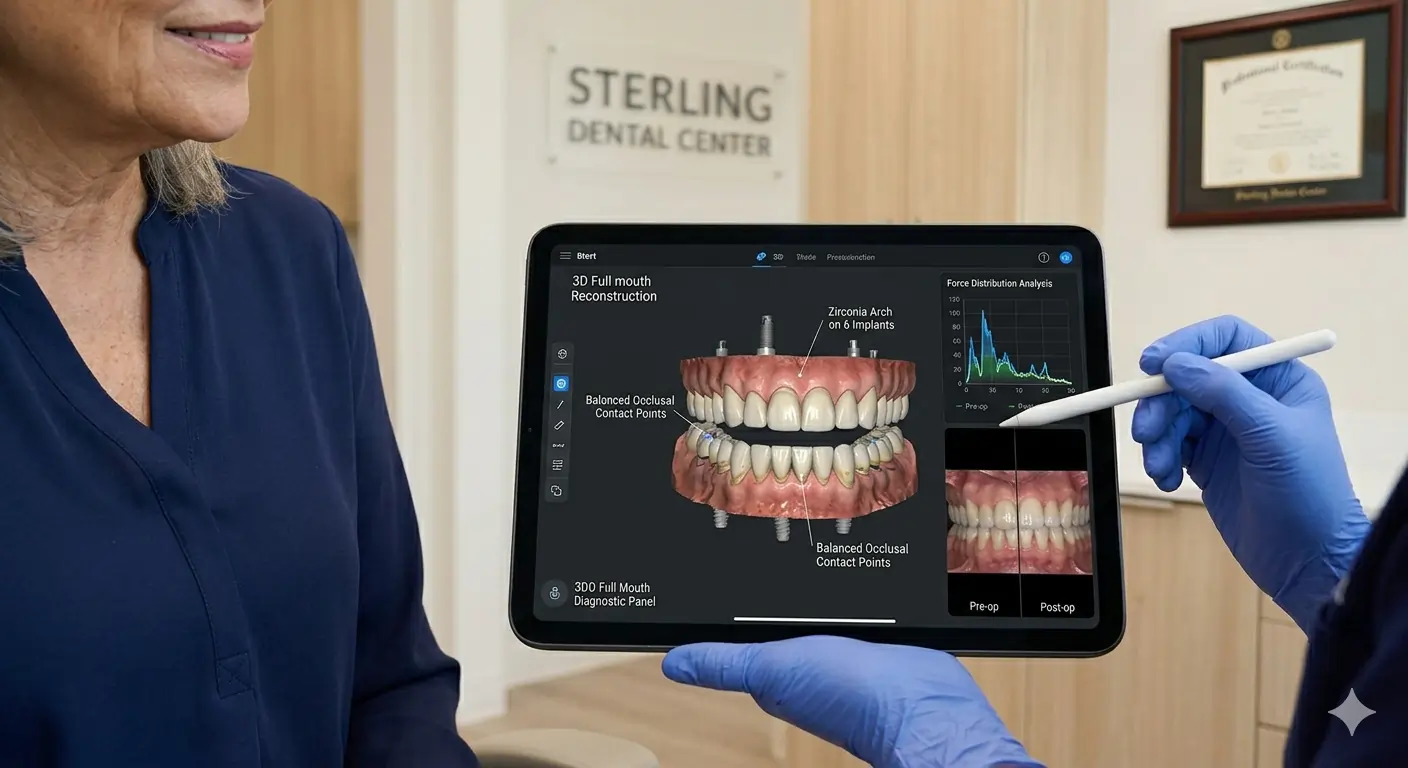
There is a certain kind of dental situation that goes beyond a single cavity or a chipped tooth. It builds slowly over years — a crack here, a crown that eventually fails, a bite that shifts, grinding that wears surfaces down faster than anyone notices. By the time most patients sit in our chair and describe what has been happening, they have been quietly managing a mouth full of compounding problems for longer than they realize.
They have adjusted the way they chew to avoid certain teeth. They have stopped smiling in photographs without quite admitting why. They have put off treatment because no single problem felt urgent enough to address — not understanding that together, those problems have been reshaping the structure of their bite and accelerating the damage to every tooth that remains.
At Sterling Dental Center, prosthodontic specialist Dr. Azim works with patients at exactly this stage — when the mouth needs more than a single procedure, and when getting it right the first time requires a level of planning, precision, and expertise that general dentistry alone cannot provide.
What full mouth rehabilitation actually means
Full mouth rehabilitation, also called full mouth reconstruction, is a comprehensive treatment approach that restores every tooth in the mouth — upper, lower, or both — in a coordinated plan designed to rebuild bite function, structural integrity, and aesthetics at the same time.
It is not a single procedure. It is a series of carefully sequenced treatments — which may include dental crowns, implant restorations, bite opening, occlusal adjustments, and other restorative work — planned around the specific anatomy and needs of the individual patient. The sequence matters. Each step is designed to support the next, so the final result is a bite and smile that function as a unified, stable system rather than a collection of independent repairs.
What separates full mouth rehabilitation from routine restorative work is the level of planning that precedes any treatment. Before a single crown is placed, a prosthodontist evaluates jaw position, bite forces, tooth proportions, wear patterns, implant sites, and long-term esthetic goals. That comprehensive evaluation is what allows the treatment to succeed not just at the point of completion, but five, ten, and twenty years later.
The warning signs most people learn to live with
One of the most consistent things we observe in patients who need full mouth rehabilitation is how long they have been adapting to their situation before seeking care. The human body compensates remarkably well for dental breakdown — shifting chewing patterns, favoring certain sides, unconsciously avoiding foods that cause discomfort. That compensation becomes invisible over time, which is why many patients genuinely do not realize how significantly their quality of life has been affected until after treatment is complete.
Some of the most common patterns that indicate the need for comprehensive evaluation include:
- Severe tooth wear Teeth that appear shorter, flatter, or more translucent than they once did are losing enamel — often from grinding, acidic erosion, or a combination of both. Once enamel is gone, it does not regenerate, and the underlying dentin wears far more quickly.
- Bite collapse When multiple teeth are lost or worn down significantly, the vertical dimension of the bite decreases. This changes the relationship between upper and lower jaws, places excessive pressure on remaining teeth, and can affect facial appearance — contributing to a sunken or prematurely aged look around the mouth.
- Multiple failing restorations Crowns, bridges, or fillings that have cracked, loosened, or failed repeatedly are often a sign that the underlying bite forces have not been properly addressed. Replacing one restoration without correcting the force distribution leads to the same failure pattern again.
- Difficulty chewing or persistent jaw discomfort When chewing has become uncomfortable, limited, or something you plan around rather than do naturally, the function of the bite has been compromised in a way that affects daily life and nutritional intake.
- An uneven or aged smile appearance Worn teeth, asymmetric gumlines, and disproportionate tooth lengths are not purely cosmetic concerns. They are often the visible result of structural problems that require a functional solution, not just a surface-level one.
Why a prosthodontist makes the difference in complex cases
Not every dentist performs full mouth rehabilitation, and the distinction matters significantly when cases are complex.
A prosthodontist is a dental specialist who completes three additional years of post-doctoral training beyond dental school, focused specifically on the restoration and replacement of teeth, dental implants, occlusion, crowns, veneers, and the management of complex bite problems. The specialty exists precisely because cases involving full mouth breakdown require a depth of knowledge about how teeth, bite forces, jaw mechanics, and restorative materials interact over time — knowledge that goes substantially beyond what is covered in general dental training.
Dr. Azim brings this specialized expertise to every full mouth rehabilitation case at Sterling Dental Center. The treatment planning process accounts not just for how the teeth look at the end of treatment, but for how the bite will function, distribute force, and maintain stability over the long term. That long-view thinking is what allows patients to invest confidently in comprehensive treatment, knowing the outcome is designed to last.
For patients dealing with worn teeth, failing dental work, missing teeth, or complex bite problems in Sterling, Ashburn, Herndon, Leesburg, Great Falls, and throughout Loudoun County, having access to this level of specialized care close to home makes a meaningful difference.
What a full mouth rehabilitation looks like in practice
Every full mouth rehabilitation is different because every patient’s situation is different. There is no single protocol — only a disciplined process of evaluation, planning, and phased treatment tailored to the individual.
In most cases, treatment begins with a comprehensive examination that includes detailed bite analysis, jaw relationship assessment, digital imaging, and discussion of the patient’s functional and esthetic goals. This information forms the foundation of a treatment plan that maps out exactly which teeth need to be addressed, in what sequence, and with which restorative approaches.
For many patients, treatment includes some combination of the following:
- Dental crowns to rebuild the structure, strength, and appearance of worn or damaged teeth
- Implant restorations to replace missing teeth with stable, root-supported replacements that preserve bone and function like natural teeth
- Bite opening to restore the vertical dimension of the bite when collapse has occurred, redistributing forces properly and improving facial proportion
- Occlusal adjustment to ensure that teeth meet evenly across the arch, eliminating the pressure concentrations that lead to premature wear and restoration failure
Treatment is sequenced carefully so that each phase builds on the last, and so the patient’s function and comfort are maintained throughout the process. The goal at every stage is a bite that works correctly, teeth that are built to last, and a smile that the patient feels genuinely good about.
A real patient. A fully rebuilt life.
The results that comprehensive full mouth rehabilitation can achieve are perhaps best understood through the experience of a real patient.
Before treatment, this patient at Sterling Dental Center had been living with severe tooth wear, multiple broken and failing teeth, bite collapse, and an uneven smile that was affecting both daily function and confidence. Years of grinding and progressive breakdown had caused loss of proper bite alignment, difficulty chewing, excessive pressure on remaining teeth, and an aged, worn-down appearance that had gradually changed the way the patient looked and felt.
Dr. Azim completed a comprehensive full mouth rehabilitation that included advanced restorative planning, dental crowns, implant restorations, bite opening, and full mouth reconstruction — all designed with long-term stability and natural esthetics as the guiding principles.
By carefully restoring the patient’s bite and jaw relationship, the treatment improved chewing function, reduced destructive bite forces, restored proper tooth proportions, and created a strong, healthy, natural-looking smile. The final result was a fully functional and aesthetic smile designed for comfort, durability, and long-term oral health — and a patient who could eat, speak, smile, and live without thinking about their teeth as a problem to manage around.
The long-term benefits of getting it right
The most important thing to understand about full mouth rehabilitation is that it is not a cosmetic upgrade. It is a structural restoration. The benefits extend well beyond appearance, and they compound over time when treatment is planned correctly from the start.
- Restored bite alignment and function Properly distributed bite forces mean every tooth is doing its share of the work — reducing the risk of future fractures, wear, and restoration failure.
- Improved chewing comfort and efficiency Patients who regain full chewing function often experience benefits they did not anticipate, including broader dietary choices and better nutritional intake.
- Reduced wear and stress on remaining teeth Correcting bite mechanics protects teeth that have not yet been affected, slowing the progression of future problems significantly.
- A more youthful, proportionate smile appearance Restoring proper tooth length and bite height has a visible effect on facial proportion, often reversing some of the aged appearance associated with dental collapse.
- Long-term stability and oral health When rehabilitation is planned by a specialist who understands the functional demands on restored teeth, the results are built to last — not just to look good at the follow-up appointment.
- Restored confidence in everyday life The psychological impact of a fully functional, healthy smile is something patients describe consistently after treatment — confidence in social situations, in professional settings, and simply in how they feel day to day.
What to do if you recognize yourself in this
If the patterns described in this piece sound familiar — worn teeth, bite problems, failing restorations, difficulty chewing, or a smile you have quietly stopped feeling confident about — the most important step is a comprehensive evaluation by someone qualified to assess the full picture.
Many patients arrive at Sterling Dental Center having been told that their situation is complicated, that they need to see a specialist, or that they have been putting things off because the scope of what needs to be done feels overwhelming. All of those situations are exactly what full mouth rehabilitation is designed for. Complexity is not a barrier — it is the reason the specialty exists.
- Schedule a consultation to get a clear, honest picture of where things stand
- Ask specifically about bite function, not just individual teeth
- Understand what a phased treatment plan would look like before committing
- Ask about implant options if missing teeth are part of the picture
- Do not wait for a single failing tooth to become a more extensive structural problem
At Sterling Dental Center, Dr. Azim and our team approach every complex restorative case with the planning, precision, and patient-centered care that these situations require. Whether you are dealing with years of accumulated damage or a more recent onset of bite and structural problems, we are here to help you understand your options clearly and move forward with confidence.
Your teeth are designed to last a lifetime. When they need rebuilding, the right specialist and the right plan make all the difference.
Contact Us Today: 703-433-0234
Visit Our Website: www.comfortfirstdentalsterling.com
Precision Implants. Natural Results. Lasting Confidence.
— The Sterling Dental Center Team